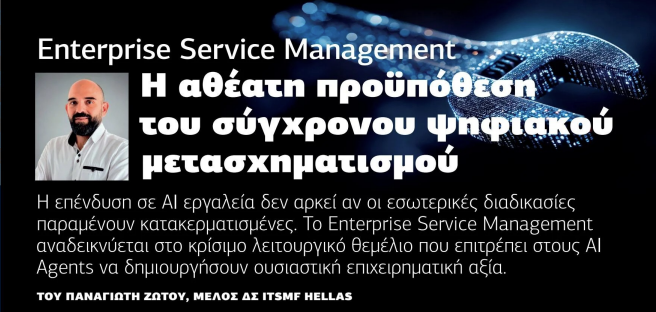
Investing in AI tools is not enough if internal processes remain fragmented. Enterprise Service Management emerges as the critical operational foundation that allows AI Agents to generate meaningful business value.
There is no business discussion today that does not include Artificial Intelligence. AI Assistants, AI Agents, and automations promise to transform how organizations operate. The question heard almost everywhere is the same: “How can we leverage AI?”
However, I believe that is the wrong question.
The right question is not how we will adopt Artificial Intelligence, but whether our organization is ready to use it. Because Artificial Intelligence can speed up a process, but it cannot fix a flawed one. On the contrary, when processes are disconnected, full of exceptions, and rely on manual actions, AI simply accelerates the chaos.
This is perhaps the main reason why many AI initiatives struggle to deliver the value they promise. Businesses invest in new tools without first investing in the way their services operate. Technology is advancing at an unprecedented pace, yet in many cases, daily operations still rely on endless emails, multiple approvals, disparate files, and fragmented cross-departmental collaboration.
Let’s look at a familiar example. Employee onboarding requires collaboration among HR, IT, Facilities, Security, and Procurement. Each team completes its own part, but often no one takes ownership of the overall service. The result is that the new employee starts without a computer, without access to necessary systems, or without the proper equipment. This is not the failure of a specific individual or department. It is a process that has not been designed as a service with a designated owner, clear targets, and measurable results.
This is precisely the core of Enterprise Service Management. It is not merely the extension of IT Service Management to other departments. It represents a shared mindset and way of working for the entire organization. Every service gains an owner, every request follows a predefined workflow, approvals are made transparently, service delivery times are agreed upon and measured, and knowledge remains accessible within the organization instead of being lost in personal emails or chats. Most importantly, all departments begin operating under common principles, a shared language, and a unified understanding of service delivery.
This is not just an organizational improvement. It is the essential foundation for the next generation of AI Agents. Digital assistants need structured processes, reliable data, clear rules, and well-defined roles. Without these, they cannot make correct decisions or reliably execute complex tasks. In other words, they require everything that Service Management has supported for decades.
That is why I believe Enterprise Service Management is not just another digital transformation project. It is the operational foundation upon which the successful utilization of Artificial Intelligence will rely. At the same time, the role of IT itself is changing. From a technology systems manager, it is transforming into a strategic partner that helps the business design, integrate, and optimize its services.
Looking ahead
In the coming years, we will see even more powerful models, smarter AI Agents, and a higher level of automation. However, the organizations that stand out will not necessarily be those that buy the next AI tool first. They will be the ones that have created an environment where services operate with consistency, transparency, and a shared purpose.
So perhaps today’s most important question is not whether we are ready for AI. Perhaps the real question is whether our services are mature enough for AI to truly transform them.
BY PANAGIOTIS ZOTOS, BOARD MEMBER OF ITSMF HELLAS netweek SEPTEMBER 2026