This article was originally published in Greek in Netweek magazine (April 2026). Author: Stamatis Passas, ViceChair, itSMF Hellas.
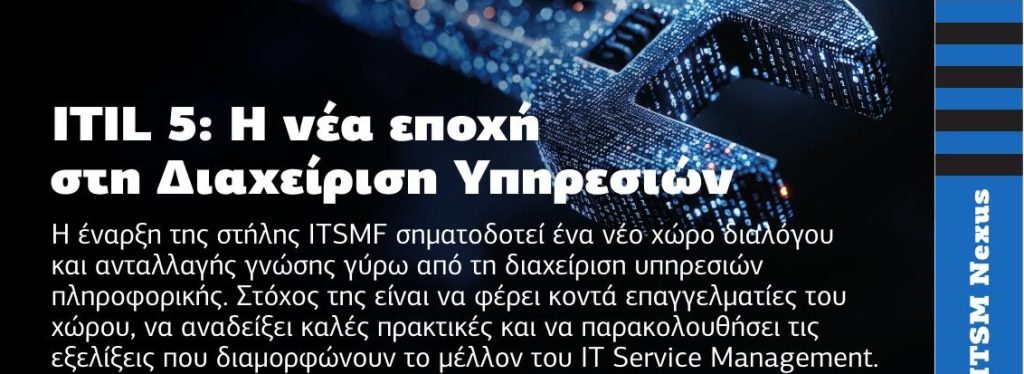
The launch of the ITSMF column marks a new space for dialogue and knowledge-sharing around IT service management. Its goal is to bring industry professionals together, highlight good practices, and track the developments shaping the future of IT Service Management.
BY STAMATIS PASSAS, VICECHAIR, ITSMF HELLAS
In this context, the arrival of ITIL 5 (ITIL Version 5) in early 2026 marks one of the most significant events of recent years. While it succeeds ITIL 4 (2019), it isn’t simply an upgrade — it’s a more mature approach that responds to growing demands for agility, speed, and the use of modern technologies.
Notably, ITIL 5 expands the Service Value System, placing emphasis on managing value streams and end-to-end visibility of services. Collaboration between teams is strengthened, incorporating practices from Agile, DevOps, and Lean Management, enabling faster and more effective service delivery.
A New Framework for Human-Centred Digital Products
At the same time, there is a clear shift from service management toward the broader management of digital products and services. In this context, the Product and Service Lifecycle Model is introduced, holistically covering every stage from design to continuous improvement.
Particular weight is given to the dimension of AI governance, with the introduction of models such as the AI Capability Model (6C), which includes capabilities like creation, curation, comprehension, analysis, communication, and coordination.
Through modern practices, organisations can identify and resolve problems at an early stage, while the use of analytics strengthens dynamic planning and decision-making. At the same time, the connection between IT and overall business strategy and risk management is reinforced — something particularly critical in environments with increased regulatory requirements.
At a broader level, ITIL 5 could be said to align with the philosophy of so-called “Industry 5.0,” where attention is paid not only to efficiency, but also to organisational resilience, sustainability, and the creation of services centred on people and their real needs.
In addition, emphasis is placed on practical, flexible guidance, as well as clear role-aligned clarity, facilitating faster implementation. Finally, adaptability and backward compatibility with existing practices allow organisations to evolve without losing the value of their existing investments.
Conclusion
In conclusion, ITIL 5 is not simply the evolution of a framework, but a more mature and modern approach to service management. In a world where change is the only constant, knowledge and adaptability are our strongest tools — and the journey toward this evolution has just begun.